

I seem to have had a lot of calls like this recently. “Cam, my fixed rate’s coming up for renewal and I’m not sure whether to lock in now or wait for rates to drop further. What would you do?”
It’s a fair question, and I get why people are asking it. We’ve just come through twelve months where interest rates have fallen by a full 2.5%, so naturally, everyone’s wondering if they’re about to miss out on even better rates just around the corner. The fear of locking in today only to see rates drop next month is real, and it’s keeping a lot of people awake at night.
But stop trying to time the market perfectly, because your ability to predict interest rate movements is about as good as gazing into a crystal ball.. So, instead of trying to pick the perfect moment, focus on managing the risk.
The 20-year reality check
When people get caught up in the current rate environment, I show them something that usually puts things into perspective: the Reserve Bank’s own data covering the last twenty years. Have a look at the two graphs below, and if you want a better look on the Reserve Bank’s website, click here. What it shows is pretty eye-opening – interest rates being under 5% doesn’t happen that often. When it does occur, it’s usually taken some kind of major catastrophe to get them there, and they don’t stay there for long.
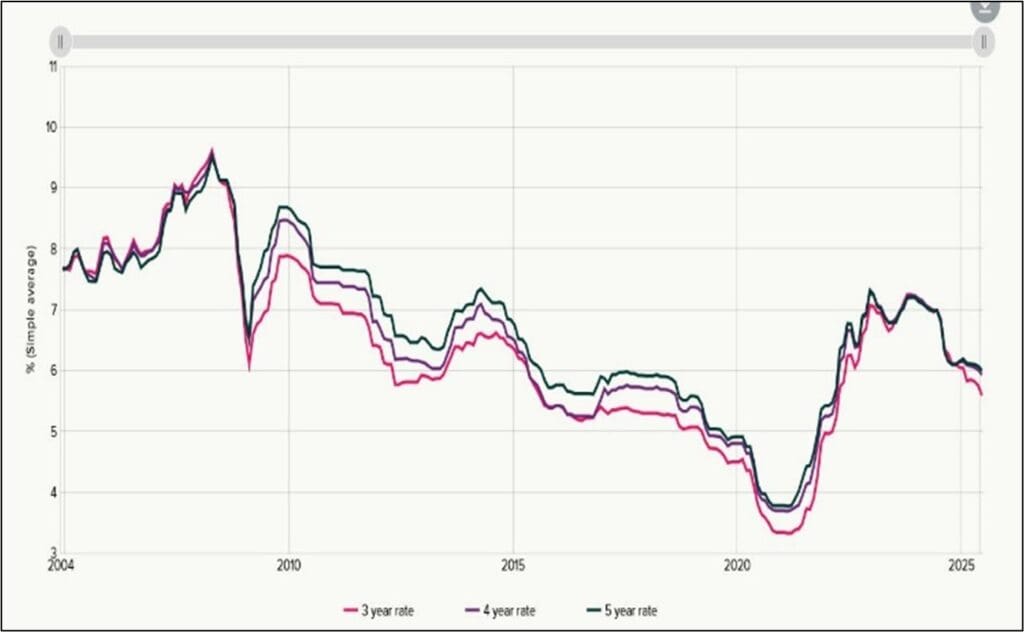
Right now, we’ve got rates sitting just under 5%, and honestly, I think that’s pretty bloody good. In the context of the last two decades, these are attractive borrowing costs, not something to be waiting around hoping for better.
I understand why people have become accustomed to rates falling – that’s been the story for the past year. But if you zoom out and look at the bigger picture, what we’re seeing now is actually quite favourable. The question is whether you’re going to take advantage of it or spend your time hoping for something even better that might never come.
The splitting solution
This is exactly why I’m such a big advocate for splitting mortgages. When someone asks me whether they should fix long or wait for rates to keep falling, my response is usually: why are you making this an either-or decision?
Consider this recent case. A client of mine was wrestling with precisely this dilemma. He held a $750,000 mortgage locked into an excellent 3.4% rate that was approaching its expiry, with renewal rates hovering around 5%. Whilst 5% remains within reasonable bounds, the monthly payment jump on such a substantial loan would be considerable.
Had he structured his mortgage differently several years earlier, he could have staggered this financial impact – absorbing portions of the increase across different periods rather than facing the full brunt simultaneously. Instead, he’d fallen into a pattern that affects countless borrowers: approaching each renewal period reactively, making hasty decisions based on whatever appeared acceptable at the time, without any strategic forethought.
Don’t get me wrong – his approach hadn’t been a complete disaster. But it certainly hadn’t been efficient either, and now he was facing a significant jump in his payments all at once.
Why one size doesn’t fit all
The thing that frustrates me is when I hear mortgage brokers making blanket recommendations at seminars. Just last month, I was at a presentation where a broker stood up and announced that everyone should be fixing for twelve months right now. After the presentation, one of the real estate agents came up to me – she was also a client – and said she was planning to follow that advice.
I had to tell her straight: that might not suit your situation at all. Her circumstances were completely different from the hypothetical ‘everyone’ the broker was addressing, and a blanket recommendation like that could have cost her thousands.
This is what I mean about context being everything. Even when I suggest that people should look at longer terms, because we’re near the bottom of the rate cycle, that advice has to be filtered through your specific situation. Maybe you’re someone who regularly makes lump sum payments, in which case, having everything on floating might make perfect sense. Maybe you’re planning major life changes that require flexibility. These factors matter enormously.
The middle ground approach
What I’ve noticed over the years is that very few people want extreme solutions. Most folks are comfortable with a middle-ground approach because it gives them wiggle room either way. It’s a bit like roulette – you could put everything on one number and potentially win big, but the odds are terrible. Most sensible people spread their bets to improve their chances.
The same principle applies to mortgage splitting. You’re essentially saying: I don’t know exactly what’s going to happen with interest rates, but I’m going to position myself so that whatever happens, I’m not completely wrong.
Getting on with life
What really matters is that while you’re sitting there trying to time the market perfectly, life is happening around you. You might get slightly cheaper rates if you wait, but you probably won’t get much cheaper, and by the time those marginal improvements come along, you might have missed other opportunities entirely.
My advice? Take advantage of rates that are historically quite attractive, split your mortgage to hedge your bets, and get on with your life. Because at the end of the day, the difference between good timing and perfect timing is usually a lot smaller than the difference between taking action and waiting indefinitely for the perfect moment that never comes.
Don’t take a crystal ball approach – contact me to have a chat first, and I’ll assess your situation and give you an honest appraisal.